
LET'S GET 21ST CENTURY ENGLISH TEACHERS HERE!
...and the teacher candidates too (:
Hello and welcome to my full of 21st- century education blog! I know you are eager to hear what is going on here! So, here you are: This is a blog specifically for in-service and pre-service English teachers but no offense! It is also for everyone who wants to learn about what 21st century learning is and what we mean by 21st century skills, and whether we, as teachers and teacher candidates, need to integrate those skills to our classes? The answer is surely "Yes!", so how can 21st century skills be integrated to the language education? Let's take a glance at it!

KEEP UP WITH THE CENTURY AS AN ENGLISH TEACHER
21st Century Learning and Teaching
We live in an constantly-changing world, and the demands of our era also change. So, is it possible to be stable for us as English teachers? IT IS NOT! Teachers are in charge of offering their students necessary life skills which have been changing in our digital age. Well, how can teachers acquire this? Absolutely, with 21st century learning! Oops, what is it? Let's put it in this way basically: the 21st century learning is an education equipped with technology and the 21st century skills which are 4Cs- creativity, critical thinking, communication, collaboration- to prepare the students for the future world. These skills are crucial to survive in the 21st century. For example, many occupations are in the center of these skills, and given the fact that English is the dominant language in every field of our age, it is irrefutable the importance of adaptation of 21st century education to the language classrooms. GOOD NEWS!: It is up to English teachers' creativity to combine their teaching with technology and 4Cs effectively. There are some ideas that I am excited to apply into my future classes, here you are!
• Creativity: Ask students to create an image benefitting from some AI tools such as Gencraft.
• Critical Thinking: Use websites/apps encouraging problem solving.
• Communication: Introduce AI tools such as Annie and ChatGPT or apps that students can speak to anyone from around the world can be useful to improve students' English communication skills.
• Collaboration: Overcome barriers of distance and time applying online meeting programmes for group projects.

ABOUT ME: THE NEW GENERATION ENGLISH TEACHER !
Who am I, and why do I have such a blog?
Hello🤗! I am Sümeyra Sabancı, a student of the English Language Teaching department of Marmara University, and I am keen about my future teaching experiences. I'm a 20-year-old art lover. I don't produce any artworks, but it is a passion for me to be able to interpret paintings (My favourite painter is Van Gogh, how about yours? 😉). What a pity to me that prior to my academic education, I didn't have the chance to receive education equipped with innovative skills which are necessary for our constantly developing world. For some reasons, I have noticed some difficulties I face as a result of this deficiency. Therefore, I have made a promise to myself! I won't be a teacher who relies on outdated methods which have no value in our century. Instead I will be a teacher who enables her students to live and use English effectively. And that's why I want to create a blog in which I share my understandings about the integration of 21st century skills to the language education.

INPHOGRAPHIC
Using Infographics in English Classrooms
Hello and welcome to my blog post for my informational infographic about cyberbullying. I take the Instructional Technologies and Material Design in English Language course, and one of the assignments of this course is to create an infographic on “legal and ethical issues in technology use”. It has several subtopics, but the reason why I picked cyberbullying is that it’s prevalent among students, unfortunately. By completing such an assignment, I -as an English teacher candidate - can increase my awareness about cyberbullying and better assist my future students if they experience cyberbullying, or are involved in cyberbullying- I hope they do not!. To design my infographic, I benefited from “Canva” which can be defined as a content designer app. During the designing process, I had difficulties answering the question “ What should I do to produce an infographic with appealing images, colors, and core information etc?”. However, once the ideas start flow, the rest is easy- just use your creativity! Regardless of whether students are young or adults, infographics can be super-effective tools for teaching English in classrooms because they are visually appealing and present key information in a concise and understandable manner. So, how? For example, the teacher can assign homework in which students are supposed to design an infographic based on the lesson content or design one according to their interests to incorporate students into the learning process enabling them to practice their English skills. Also, teachers can use infographics as lesson materials to teach some topics in a more interesting way.
CREATING A PODCAST
We not only read texts but also listen to podcasts on Internet. Given the widespread use of podcasts across various topics, there is no doubt that it can be accepted that creating a podcast has a variety of advantages in English classrooms. So, as an English language teaching student, I was supposed to create a podcast in which I shared my idea to make the world a better place to live in inspired by "60secs idea to improve the world" segment on the BBC. In order to complete my task, I had to come up with an original idea at first. I always had some bright opinions about the issue, so it was not challenging to find an idea for me. However, writing the script, and finding a silent place to record the podcast smoothly were a little bit difficult, to be honest. Nevertheless, completing that phase was the most satisfying part of the task completion. Finally, I intended to add some additional features, but I failed due to some technical problems. Overall, it was an entertaining and interesting task with no disadvantages; on the contrary, it has advantages such as improving creative thinking skills, technology literacy, and improving English language skills etc. That's also why I would assign a similar task to my learners in the future.
Video Channel
Video Channel


Morning Rush

Into the Blue

Beach Patrol

Towering Heights
CREATING A DIGITAL STORY
Here is the PSA: https://youtu.be/5khT55-OLts?feature=shared
Hello everyone 🤗 I was assigned to create a Public Service Announcement (PSA) as a group homework. PSAs are announcements to inform the public on a specific issue. PSAs:
Deliver the idea briefly and effectively.
Aim the audience to take action.
Are persuasive
First, my friends and I decided on our topic. It was about autism spectrum disorder which can be commonly seen in public, so awareness needed to be raised about it. One of our friends advised the other members to use a sound effect related to the content, and she also prepared the transcript by receiving the others’ approval. Then, every member of the group prepared and designed their own slides. Individually, I started my search looking for related images regarding the licensing rights. In order not to break the rights, I benefited from the Creative Commons. I recorded my part of the transcript, and combined everything using Canva, paying attention to the time limit. Finally, we compiled our parts into a single file, and one of our friends added the sound effect because she had necessary devices. As a student, I certainly find the homework beneficial and improving, and as a teacher candidate, I plan to assign my future students this kind of video homework to improve their language skills, digital literacy, and higher thinking skills.

ONLINE COLLABORATIVE WRITING
The Silence of the Lambs
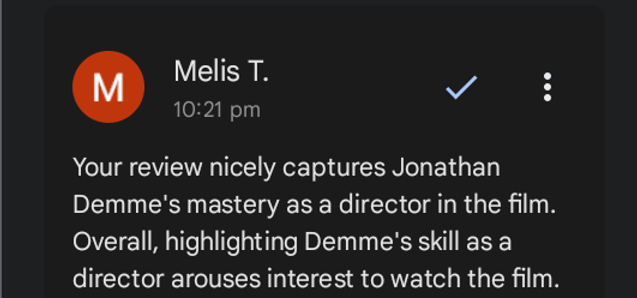
My scholar assigned us an online collaborative writing task in the Information and Communication Technology and Material Design course. As can be understood from its name, it was a collaborative task, so I set up a group with my friends ( Azra Yakıcı and Zeynep Sude Seven). We were supposed to write a film review with four paragraphs counting about 400 words on Google Docs. Then, we had to receive feedback from another group, and give feedback on their review. First, we decided on the film we want to write about: “the Silence of the Lambs”, a masterpiece of cinema history. I wrote the first paragraph that contained the name of the film, name of the director, prominent stars of the film, basic setting (time and place), and genre. The other group members wrote the next two paragraphs, containing a short plot summary and important elements of the film, respectively. Then, we wrote the fourth paragraph including our own ideas about the film. Throughout the task, we used useful language for the review. We also added some images related to the movie and a YouTube link to the trailer. Finally, we received feedback from another group, and also sent feedback to them. Overall, the process was issueless. Doing research, creating something authentic, and working with your friends was enjoyable and motivating for further assignments. When it comes to Google Docs as a collaborative writing tool, I believe it doesn’t matter if you are familiar with the Google Docs or not because it is basic to understand and use. I find Google Docs very beneficial because it allows multiple individuals to work on the same file, making the process easier and faster. Google Docs also allows you to add some external elements to the same file such as links and images. You can easily leave comments on the same file, too. As a teacher candidate, I plan to assign my future students to such a task which enables them to work on an online platform collaboratively.



AI TOOLS IN LANGUAGE LEARNING AND TEACHING
Magic School
As the final assignment, I was supposed to engage with AI tools- Magic School's Character Chatbot and Writing Feedback Tool. Magic School is an AI tool which enables students to benefit from different learning opportunities. Throughout the process, I experienced the advantages of the tools. First of all, Character Chatbot- in which you can chat with whoever you want- boosted my motivation to complete the task, making it joyous. Human-like answers regarding the personality of the character, responses with an attitude taking my opinions into consideration, and being willing to elaborate communication by asking questions are beneficial features of the tool. Similarly, the Writing Feedback Tool is also good at its job! Comparing these tools with other AI feedback tools, Magic School is the best. It gives you detailed feedback regarding your level of education. Also, it offers optional questions which enables you to get more detailed feedback. İt also enables you to practice self-learning by showing how to revise your tasks. Overall, as a student, I find Magic School AI tools quite successful. On the other hand, as a teacher candidate, I would like to engage my future students with such AI tools to improve their language skills both inside and outside the classroom. Also, AI is an effective way of improving digital literacy of students, which is an indispensable skill in the 21st century. Despite AI tools' diverse benefits, integrating AI into classrooms has some flip sides, too. One of them is ethical issues. When they enjoy the ease of AI, students may tend to apply to AI even when it is not allowed by the teacher. If students use AI too much, that might endanger their academic development, restricting creativity. To prevent unwanted usages of AI, teachers have so much burden on their shoulders in such a case. Overall, however, integrating AI into language classrooms makes learning more enjoyable and interesting for the learners of the technology age!

INSTRUCTIONAL TECHNOLOGIES AND MATERIAL DESIGN IN ENGLISH LANGUAGE
As the final assignment, I was supposed to engage with AI tools- Magic School's Character Chatbot and Writing Feedback Tool. Magic School is an AI tool which enables students to benefit from different learning opportunities. Throughout the process, I experienced the advantages of the tools. First of all, Character Chatbot- in which you can chat with whoever you want- boosted my motivation to complete the task, making it joyous. Human-like answers regarding the personality of the character, responses with an attitude taking my opinions into consideration, and being willing to elaborate communication by asking questions are beneficial features of the tool. Similarly, the Writing Feedback Tool is also good at its job! Comparing these tools with other AI feedback tools, Magic School is the best. It gives you detailed feedback regarding your level of education. Also, it offers optional questions which enables you to get more detailed feedback. İt also enables you to practice self-learning by showing how to revise your tasks. Overall, as a student, I find Magic School AI tools quite successful. On the other hand, as a teacher candidate, I would like to engage my future students with such AI tools to improve their language skills both inside and outside the classroom. Also, AI is an effective way of improving digital literacy of students, which is an indispensable skill in the 21st century. Despite AI tools' diverse benefits, integrating AI into classrooms has some flip sides, too. One of them is ethical issues. When they enjoy the ease of AI, students may tend to apply to AI even when it is not allowed by the teacher. If students use AI too much, that might endanger their academic development, restricting creativity. To prevent unwanted usages of AI, teachers have so much burden on their shoulders in such a case. Overall, however, integrating AI into language classrooms makes learning more enjoyable and interesting for the learners of the technology age!
THE CURRENT ISSUES IN TEACHING
This year, in my third year of university education, I am taking the "Current Issues in Teaching" course taught by Assist. Prof. Mustafa Polat this year, as a similar one to last year's course “ICT and Material Design”. I am, as you know from my previous posts, an English Language Teaching (ELT) student at Marmara University. Also, I am a language teacher candidate who is extremely curious about technology integration into language education. This is one reason why I have this blog, another reason is that One of the reasons I have this blog is that it is my course's requirement to have such a blog in order for us to reflect on our experiences on technology usage as a learning- teaching tool, and to become active participants in exploring this subject. So, let me introduce you the objectives of this course:1. Teaching pre-service teachers why technology is so important for English classes,2. Teaching ideas about technology integration to language lessons, and3. Creating an environment to practice what is learnt in the class through lesson plans, and material designs. Thanks to this course, I will have the opportunity to expand on my previous knowledge from the "ICT and Material Design" course, and explore new educational technologies. Throughout the semester, I will be sharing my experiences and thoughts about the assignments, lesson plans, and materials that I will design. I'm excited to have you for this journey once again!
A CORPUS-BASED MATERIAL DESIGN
A corpus is basically an online collections of texts. It enables you to search for various aspects of words such as collocation, and frequency. Therefore, it is beneficial for language learning and teaching. To prepare a corpus-based material, we worked in a group of three, and we decided on teaching the eight crime words in Unit 12, Defective Stories (from the English preparation books assigned by the instructor). The intended audience is B1 level high school preparation class learners. Additionally, the material has to be visually engaging. Through the first two activities, learners' existing knowledge is tested regarding the crime types. To complete the next two activities, they need to use the corpus, specifically COCA, according to the instructions presented by the teacher at the final page of the material. Learners find two most frequently used verbs with specific crime words, and then they are supposed to differentiate the nuances between the crime types. After learners have the necessary knowledge about the words, they write their own sentences. Finally, learners wrap up what they practice with the fill-in-the-blank activity, and have a discussion session which allows them to unveil their thoughts about crime in general. The lesson plan of this material was prepared based on the ASSURE model which enables teachers to plan their lessons effectively. The design process of the material is enjoyable, easy and motivating for me as a teacher candidate, except for the given corpus instructions which needs my understanding first of all. The assignment demonstrated to me how I can present vocabulary effectively, activating students’ cognitive depth, and how I can lead my students to inductive learning. However, internet connection problems, gaps about the usage of corpus in learners’ minds , or some learners’ unsuccessful usage of corpus might be the possible problems in a real classroom. Teachers should have a B-plan for such problems.
THE LINK OF THE MATERIAL: https://www.canva.com/design/DAGXTg1c5L8/oYxuA0iiRscPsyohFcmrRg/edit?utm_content=DAGXTg1c5L8&utm_campaign=designshare&utm_medium=link2&utm_source=sharebutton
THE LINK OF THE LESSON PLAN: https://docs.google.com/document/d/1V5wGN1Q8-XwZdpbobKUIv515_Qn0-8PS1Q41O5VTwKs/edit?usp=sharing
Have you ever heard about flipped learning? Let's have a look!
If you complain that you cannot make your students practice language in the classroom enough, you can allocate classroom time to more communicative activities by recording your lesson subject (e.g. vocabulary, grammar so on.), and sharing it with your students to watch it before the class. Flipped learning has other advantages, as well. Your students can build a deeper understanding by watching videos as many times as they need. They can personalize their learning by watching the content whenever and wherever they want. Also, the teacher can create more enjoyable content in a shorter time. However, don't forget to consider flipped learning’s disadvantages, as well. Some students may not watch the recorded lesson before the class, or may feel uncomfortable with this relatively uncommon learning style. For teachers, it is an extra-load, too! Now, let me share my experience with you. I was assigned to create a 3-minute recorded lesson with a group of three. We decided on 15 daily routine phrases in the 5th grade coursebook shared by my instructor. I created a 5-page slide with related images, sentence examples, and the words (get up, wash hands, brush teeth, have breakfast, comb hair) on Canva. Then, I recorded my teaching on Zoom using these Canva slides, paying attention to make the video interesting for young learners. Finally, we combined our videos and created an additional quiz using Wordwall to assess students' understanding. Throughout the process, recording and editing the videos was the major problem for me, which required using different Zoom features such as changing wallpaper and sharing the screen. To handle these problems, I asked my friends how they solved the problems, and I searched on Google how to use Zoom more effectively. To sum up, it was not a super-challenging task to do. Also, I find it beneficial, and I look forward to integrate flipped learning into my future teaching
THE LINK OF THE VIDEO: https://www.canva.com/design/DAGYcQPUMk0/opJa2W9qDtsBS1yF3gKo9A/edit?utm_content=DAGYcQPUMk0&utm_campaign=designshare&utm_medium=link2&utm_source=sharebutton
THE ASSURE LESSON PLAN: https://docs.google.com/document/d/1ZWJnWymXOtgTuHY5Pw5YcD1ogq04FIeURJJ5zJClX8Y/edit?usp=drivesdk
THE LINK OF THE QUIZ: https://wordwall.net/resource/83550252

THE MORE REAL, THE MORE EFFECTIVE- VR and AR
Have you ever heard/used virtual reality (VR) and/or augmented reality (AR) before? How about in language teaching/learning?
VR is a technology creating a realistic environment in which people can interact with it. AR is another technology that integrates virtual elements into the real world. Integrating them into language classes has been a recent issue with the technological developments. Both, called as emerging technologies, have pros and cons in language education. They create a sense of reality which enables students to use English for authentic purposes. Also, it is more appealing for students than traditional learning environments. Thus, students can improve their various language skills including speaking, vocabulary and so on. On the other hand, these technologies can be problematic regarding accessibility, health concerns, technical issues etc. At that point, teachers’ careful planning is the best solution.
GOOD NEWS: I have an example of a material based on VR and AR. As a requirement of the course I take, my friends and I designed a material enabling students to explore Arizona. It includes three sections: Introduction of two landmarks of the city, introduction of a museum, and activities done around Arizona. I prepared the landmark section, which introduces the Grand Canyon and the Meteor Crater. The preparation process was smooth and enjoyable- Yes, I also enjoyed exploring these technologies for educational purposes. Finally, I plan to integrate VR and AR into my future teaching since I believe in its benefits for English teaching and learning.
The the Website and YouTube Videos We Used:
The Worksheet We Designed;
HOW ABOUT ARTIFICIAL INTELLIGENCE (AI) IN LANGUAGE CLASSROOMS?
Artificial Intelligence (AI) has started to be an inevitable part of the future, so integrating it into language teaching is a must. My friends and I designed a material requiring students to use ChatGPT- an AI tool- to get feedback on their writing. I prepared the main task which is a writing task. First, students write a comparison paragraph about online shopping and shopping at a store. Then, they ask ChatGPT the questions provided by the teacher to receive feedback. These questions focus on areas such as grammar, vocabulary, and clarity. Based on the feedback they receive, students revise their paragraph and paste it into the online material. This task was easy and motivating to prepare because I want to raise my future students’ awareness about the effective use of AI in developing their language abilities.
MORE ABOUT THE MATERIAL:

MY DEAR FOLLOWERS,
This is the end of my journey for the course ‘Current Issues in Teaching’ and I want to share my opinions about it. First of all, understanding the course was easy thanks to the instructor’s clear lecturing. However, it was challenging to prepare so many assignments nearly every week, although the tasks were not too demanding. Seeing various examples of how to apply technology in our teaching contributed to my understanding of the topic and professional development by equipping me with knowledge and practice. I believe this is the lesson’s greatest strength, but we could not present our materials to the class and observe how they would work in a classroom context, which was the lesson’s mere weakness. I, absolutely, have a favourite of the tasks amongst corpus based, flipped-learning, AR/VR, and finally AI tasks although I appreciate all. It is the AI task because it is significant to enable students to control their learning without relying too much on the teacher and raise their awareness of effective use of the AI tools. On the other hand, my least favourite task is flipped-learning since our teaching-learning context is not ready to implement such an innovative approach. I am concerned because it requires a great deal of responsibility from students, which they must already have. Unfortunately, this is not something I could not observe throughout my education before university. Nevertheless, it has advantages, and I am still eager to give flipped learning a try in the future! Finally, I suggest allocating some time for presentations so that pre-service teachers can experience applying their materials in a classroom context.
For the students who will take the course next year: Be ready to teach students born into technology by designing technology-integrated materials.